Canada remains one of the most attractive destinations for international workers because it offers strong salaries, a stable economy, and clear immigration pathways. For many people, getting legal permission to work in Canada is the first big step toward building a better future abroad. That is why understanding the Canada Work Permit 2026 process is so important for job seekers who want to move with confidence instead of relying on guesswork.
In 2026, Canada is expected to continue welcoming foreign workers in sectors such as trucking, construction, agriculture, healthcare, hospitality, and skilled trades. But before you can start working, you need to understand how the permit process works, what documents are required, which permit type fits your situation, and how to avoid mistakes that delay approvals.
This guide is written to help real users, not confuse them. If you want a practical, human-style explanation of Canada Work Permit 2026, you’re in the right place.
Canada Work Permit 2026 – Types, Eligibility, Documents & Step-by-Step Application Process
The term Canada Work Permit 2026 refers to the legal authorization that allows a foreign national to work in Canada for a specific employer or, in some cases, more openly depending on the permit type. While the process can look complicated at first, it becomes much easier when you break it down into simple steps.
For many applicants, Canada Work Permit 2026 is linked to a job offer from a Canadian employer. In other cases, a spouse, graduate, or eligible applicant may qualify for an open work permit. The key is knowing which route applies to you before you begin.
What Is a Canada Work Permit?
A work permit is an official document issued by the Canadian government that gives a foreign national permission to work in Canada for a certain period. It is different from a visitor visa or study permit because it is specifically tied to employment rights.
In most cases, Canada Work Permit 2026 falls into two broad categories:
1) Employer-Specific Work Permit
This type allows you to work for one employer, in one approved role, under specific conditions. It often includes:
- Employer name
- Job location
- Job title or work category
- Duration of the permit
Many foreign workers enter Canada through this route.
2) Open Work Permit
An open work permit allows you to work for most employers in Canada without being tied to one company. This option is available only in certain situations, such as:
- Spouses of some workers or students
- Some international graduates
- Specific public policy programs or special categories
Understanding the difference is essential before applying for Canada Work Permit 2026.
Who Needs a Work Permit in Canada?
Most foreign nationals need a work permit if they want to work legally in Canada. There are a few limited exceptions for business visitors or special short-term cases, but for the majority of job seekers, Canada Work Permit 2026 is a necessary part of the process.
If you are planning to move to Canada for employment, do not assume a job offer alone is enough. In most cases, you still need proper work authorization.
Main Pathways to Get a Canada Work Permit in 2026
There are several ways people may qualify for Canada Work Permit 2026, depending on their situation.
A) Work Permit Through a Job Offer
This is the most common route. A Canadian employer offers you a job, and that job may support a work permit application. In many cases, the employer may also need an LMIA (Labour Market Impact Assessment) to prove that hiring a foreign worker is justified.
B) LMIA-Based Work Permit
An LMIA-based application is common when the employer cannot find a suitable Canadian worker. Once the employer gets a positive LMIA and gives you the job offer, you may apply for Canada Work Permit 2026 with the supporting documents.
C) LMIA-Exempt Work Permit
Some jobs or categories are exempt from LMIA rules. This may apply under international agreements, intra-company transfers, public-interest categories, or certain academic and professional programs.
D) Open Work Permit Routes
Some people do not need a specific employer to apply. This includes certain spouses, post-graduation applicants, or others eligible under special policies.
Eligibility Requirements for Canada Work Permit 2026
The exact requirements depend on the permit type, but many applicants for Canada Work Permit 2026 should expect to show the following:
- A valid passport
- A genuine job offer if applying for an employer-specific permit
- LMIA documents if required
- Proof that you meet the job qualifications
- Clean criminal background if requested
- Medical exam if required for your role or travel history
- Evidence that you will follow permit conditions and leave Canada if required
The visa officer must believe your application is genuine, complete, and legally eligible.
Documents Required for Canada Work Permit 2026
A strong application depends heavily on proper paperwork. While the exact list can vary, these are common documents used for Canada Work Permit 2026 applications:
- Valid passport
- Job offer letter
- LMIA approval letter (if required)
- Employment contract or supporting employer documents
- Educational certificates
- Experience letters or CV
- Passport-size photographs if requested
- Medical exam report if required
- Police certificate if requested
- Marriage documents if applying with spouse or family
One of the biggest reasons for delays is incomplete or inconsistent documentation, so every document should be clear and accurate.
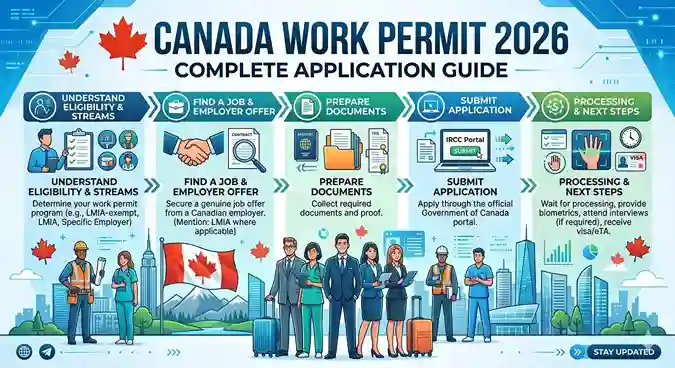
Step-by-Step Canada Work Permit Application Process
If you want to understand Canada Work Permit 2026 properly, the easiest way is to follow the full process step by step.
Step 1: Find the Right Job or Permit Route
Start by identifying whether you are applying through an employer-specific route, LMIA-based route, or open work permit category.
Step 2: Collect Employer Documents
If your permit depends on a job offer, gather the job offer letter, employer details, LMIA information (if needed), and contract documents.
Step 3: Prepare Your Personal Documents
Make sure your passport, CV, education records, work experience documents, and identity records are ready.
Step 4: Complete the Online Application
Most applicants submit their Canada Work Permit 2026 application online. Fill every section carefully and upload supporting documents exactly as requested.
Step 5: Pay the Required Fees
Application fees depend on the permit type. If biometrics are required, there may be an additional fee.
Step 6: Give Biometrics
Many applicants must provide fingerprints and a photo at an approved biometrics center after submission.
Step 7: Attend Medical Exam if Needed
If your job involves healthcare, childcare, or if you lived in certain countries, you may need a medical exam from an approved panel physician.
Step 8: Wait for Processing and Decision
Processing time depends on your country, permit type, and application quality. If approved, you’ll receive instructions or a port-of-entry letter depending on your case.
This is the core path most applicants follow when applying for Canada Work Permit 2026.
How Long Does Processing Take?
There is no single fixed timeline because Canada Work Permit 2026 processing depends on many factors:
- Your country of residence
- Type of work permit
- Whether biometrics or medical exam are needed
- Whether your application is complete
- Seasonal workload at immigration offices
A complete and well-organized application generally has a better chance of moving smoothly than one with missing or weak documentation.
Can Family Members Come With You?
In many situations, yes. Depending on your permit type, your spouse may be eligible for an open work permit and your children may be able to study in Canada. However, this depends on your job level, permit category, and current immigration rules.
For many applicants, Canada Work Permit 2026 is not only about one job—it can also become a family relocation pathway if planned properly.
Common Reasons Work Permit Applications Get Refused
Many refusals happen because applicants underestimate the importance of detail. Some common problems include:
- Incomplete documents
- Weak proof of job eligibility
- Unclear employer paperwork
- Suspicion that the job offer is not genuine
- Inconsistent travel, identity, or employment history
- Poor explanation of the purpose of travel or work plan
If you are serious about Canada Work Permit 2026, it’s worth reviewing every document before submission.
Tips to Improve Your Approval Chances
To make your Canada Work Permit 2026 application stronger, follow these practical tips:
- Apply only through a genuine job offer or valid permit category
- Double-check every uploaded document
- Make sure names, dates, and job details match everywhere
- Keep your passport valid for a good period
- Write clear explanations if your case has anything unusual
- Avoid fake agents or suspicious shortcuts
- Follow official instructions carefully
A clean, honest, and well-prepared file can make a huge difference.
Can a Canada Work Permit Lead to Permanent Residency?
Yes, in many cases it can. One of the biggest advantages of Canada Work Permit 2026 is that Canadian work experience may later support immigration pathways such as Express Entry or Provincial Nominee Programs. A work permit itself is temporary, but it can become a stepping stone toward long-term settlement if you plan wisely.
Final Thoughts
If you want to work abroad legally and build a stable future, understanding Canada Work Permit 2026 is one of the smartest places to start. The process may seem technical at first, but when you break it into job offer, documents, eligibility, application steps, and follow-up, it becomes much more manageable.
The most important thing is not to rush blindly. Choose the right permit type, prepare your documents properly, use only genuine employer information, and apply carefully. With the right planning, Canada Work Permit 2026 can be more than a permit application—it can be the beginning of a new life, a better job, and a long-term opportunity in Canada.